
Research
Nanomaterial Sponge Coatings for Heavy Metal Remediation and Nutrient Recovery
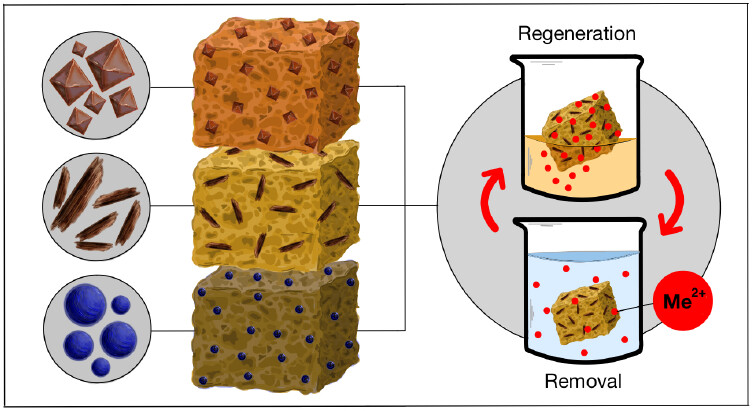
After the previous successes of my lab group in using sponge nanocomposites for oil spill remediation and nutrient recovery, I worked on designing nanomaterial coatings for mass-produced cellullose sponges to transform them into sorbents for remediating heavy metals and recovering critical elements from aqueous sources. We called this platform approach “Nano-SCHeMe”: Nanomaterial Sponge Coatings for Heavy Metals.
This work was published in ACS ES&T Water and reported on by Fast Company, New Atlas, and Northwestern Now, and presented on at meetings of the American Chemical Society.
Previously, I had worked under lead author, Stephanie Ribet, on the Phosphate Elimination and Recovery Lightweight (PEARL) Membrane, a sustainable solution to the problem of phosphate pollution and hypereutrophication. A cellulose sponge, coated with a nanomaterial slurry, can recover phosphorus, an essential nutrient, from wastewater. Our work was published in PNAS and reported on by Anthropocene, New Atlas, and the Daily Mail.
We more recently continued the testing of the PEARL membrane at larger scales to bridge the gap between lab-scale science and field-scale technology. Working under lead author Kelly Matuszewski, our work on utilizing pH to differentially recover metals and nutrients concurrently from stormwater is published in ES&T Water and reported on by Forbes and the National Science Foundation.
Collaborative Scientific Work
Working under lead author Nishithan Kani, I worked on characterizing and imaging cobalt oxide nanoclusters on graphene, used for the electrochemical reduction of nitrates with an extremely high selectivity for ammonia. Scanning transmission electron microscopy (STEM) and x-ray photoelectron spectroscopy (XPS) experiments were conducted to better understand the structure of the material and the cobalt oxide. This work was reported in Advanced Energy Materials.
In collaboration with lead author Jeremy Wang, as well as Caroline Harms and John Hegarty, two other members of my lab group, we worked to understand a process by which polyelectrolyte complexes sequester nanoplastic contaminants in water. I also worked to test the adsorption of lead to the nanoplastics to observe the process by which nanoplastics, during the polyelectrolyte complex sequestration process, can also pull out other contaminants from water with them. This work was published in ACS Langmuir.
Other research projects that I have worked on over the years:
- Molecular dynamics (MD) and density functional theory (DFT) simulations of titanium dioxide, coupled with transmission electron microscopy (TEM) image simulations, to better understand structure around oxygen vacancies as viewed in TEM imaging. Please do not judge my undergraduate honors thesis on this subject, I was very young.
- Testing manganese oxide nanomaterials for their utility in recovering cobalt and nickel from aqueous sources such as waste site runoff or mine tailings.
- Making a bunch of ionic liquid dilutions and observing how the viscosity, conductivity, and thermal properties of the resultant mixtures changed due to molecular ordering with an inflection point at a 1:1 molar ratio.
- Adding glass waste to concrete to optimize additively-manufactureable concrete blends and utilize windshield waste.